Validator Containers (Advanced Validators)
Validator containers run advanced validations such as EnergyPlus, FMU, SHACL, Schematron, Portfolio Manager, and PDF. They support two deployment modes:
- GCP managed execution: Cloud Run Services are the normal route, with retained Cloud Run Jobs for author-selected long-running work and rollback
- Docker Compose (Docker): Sync execution with local filesystem storage
GCP mode: provider-selectable Services and Jobs
We deploy one Django image as two Cloud Run services:
- $GCP_APP_NAME-web (
APP_ROLE=web): Public UI + public API. - $GCP_APP_NAME-worker (
APP_ROLE=worker): Private/IAM-only internal API (callbacks).
Every advanced attempt snapshots one verified ValidatorExecutionDeployment.
The workflow step's provider-neutral execution_profile selects the route
before dispatch: FAST_RESPONSE uses the ready primary route and
LONG_RUNNING uses the retained long-running route. In normal operation those
are a Cloud Run Service and Cloud Run Job respectively. During explicit
operator rollback the Job is primary and can truthfully satisfy either profile.
Both runtimes call the worker using Google-signed ID tokens and the attempt
callback nonce. There is no shared callback secret and no runtime failover.
In environments with a custom public domain (production), SITE_URL points at the public domain (for example https://validibot.com) while WORKER_URL points at the worker service *.run.app URL. Callbacks and scheduled tasks should always target WORKER_URL, never SITE_URL.
Flow overview
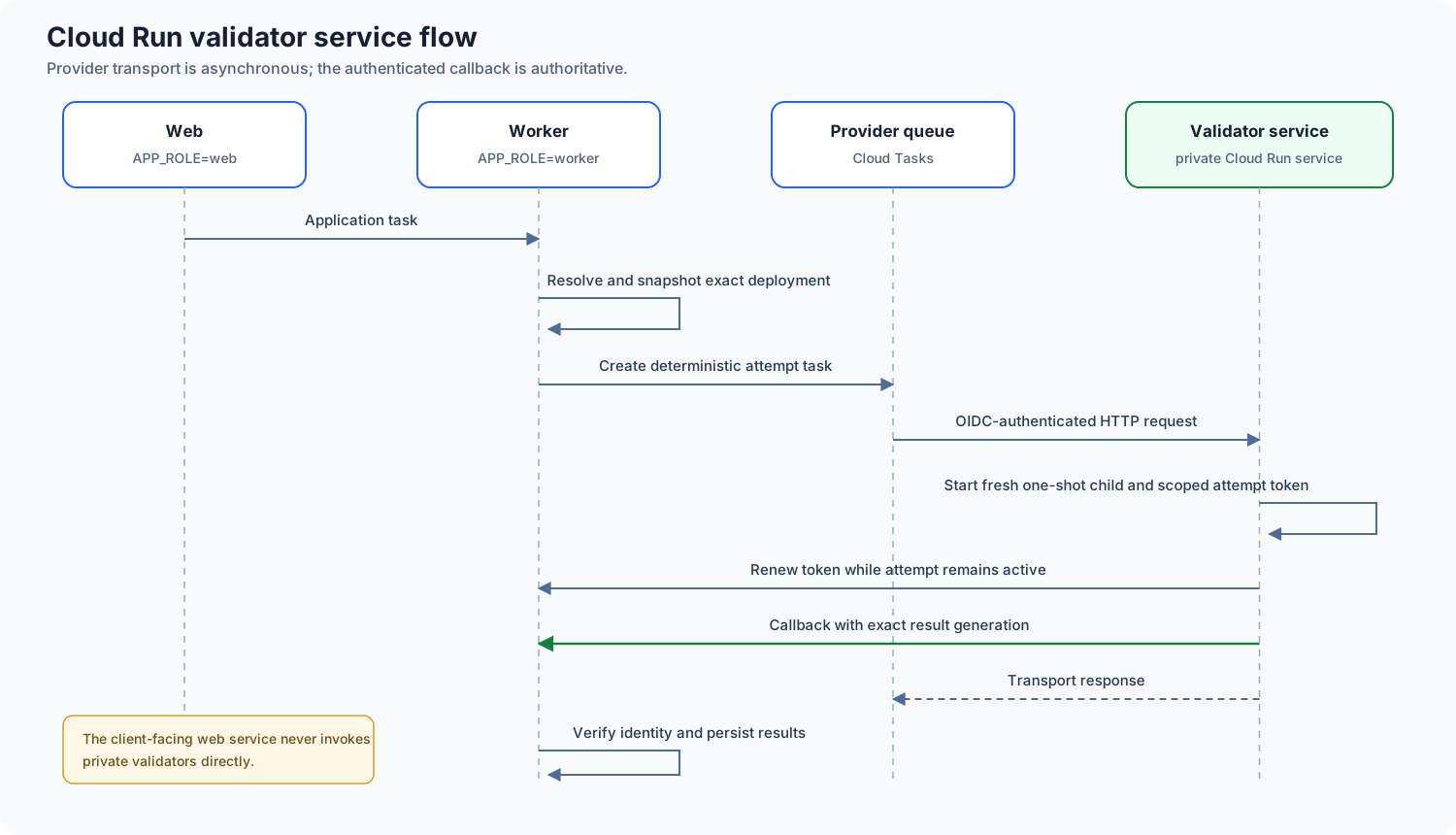
IAM roles involved:
- Web/Worker service account (
$GCP_APP_NAME-cloudrun-{stage}): Customvalidibot_job_runnerrole (the historical ID now represents the validator controller) so Django can read exact Job/Service configuration, verify Service invoker IAM, and call the Jobs API with overrides forVALIDIBOT_INPUT_URI. - Validator runtime service account (
$GCP_APP_NAME-validator-{stage}): Used by both Services and Jobs. It hasroles/run.invokeron the worker for callbacks and renewal, but no project or bucket storage role. Django supplies a short-lived Credential Access Boundary token limited to one attempt prefix and theroles/storage.objectViewer+roles/storage.objectCreatorpermission ceiling. - Provider-task invoker (
$GCP_APP_NAME-val-invoker-{stage}): Has no project roles. It is the onlyroles/run.invokermember on the six private validator Services and is attached only to provider-queue tasks. The abbreviated resource name stays within Google's 30-character service-account ID limit forprod,staging, anddev. - Worker: private, only allows authenticated calls; rejects callbacks on web.
Cloud Run Jobs remain a separate execution shape. They have queryable provider status and may run for up to their configured long-running budget. Cloud Run Services have no durable per-request status resource, so callback/output reconciliation is authoritative and their transport task is deterministic.
Custom IAM Role
The standard roles/run.invoker role only includes run.jobs.run, but
triggering Jobs with environment variable overrides (like
VALIDIBOT_INPUT_URI) requires run.jobs.runWithOverrides. Deployment import
and hourly drift verification must also read each exact Job or Service and the
Service invoker policy before trusting it. We use a narrow project-level custom
role rather than the much broader roles/run.viewer:
# Role: projects/$GCP_PROJECT_ID/roles/validibot_job_runner
# Permissions:
#   run.jobs.get
#   run.jobs.run
#   run.jobs.runWithOverrides
#   run.services.get
#   run.services.getIamPolicy
The role ID is retained for compatibility. just gcp init-stage reconciles the
role and its project-level binding; just gcp validator-job-deploy also retains a
resource-level binding on each Job. The role cannot list unrelated resources,
change a Service, or change IAM.
Why env + GCS pointer: Cloud Run Jobs only accept per-run overrides via env/command; we keep large envelopes in GCS and pass the input URI plus its short-lived attempt token as execution overrides. Cloud Run documents that environment values are visible to project viewers, so treat execution-view permission as privileged. The token is still bounded to one attempt and a short lifetime, is never logged or persisted by Validibot, and cannot delete or replace an existing object.
Status tracking: We record the Cloud Run execution name and a job_status using CloudRunJobStatus (PENDING/RUNNING/SUCCEEDED/FAILED/CANCELLED) in launch stats for observability and fallback polling; run/step lifecycle still uses ValidationRunStatus/StepStatus.
Why we use a callback_id in addition to run_id
Cloud Run retries callbacks if delivery fails. The run ID tells us which resource to update, but it does not distinguish one delivery attempt from another. Without a per-callback token we would reapply findings and status every time the platform retries, or we would have to drop all later callbacks for that run.
The launcher generates a unique callback_id for each job execution and puts it into the input envelope. The validator echoes it back in the callback. The worker uses that ID to fence retries: the first delivery creates a receipt; any repeat with the same callback_id returns immediately as a replay. This lets us ignore duplicate deliveries while still accepting legitimate future callbacks for the same run (for example, another step or a rerun).
Deployment steps
- Build/push Django image (same for web/worker)
- Deploy web:
--allow-unauthenticated--set-env-vars APP_ROLE=web- Deploy worker:
--no-allow-unauthenticated--set-env-vars APP_ROLE=worker- Set
WORKER_URLin the stage env file to the worker service URL (see below) -
Grant
roles/run.invokeron$GCP_APP_NAME-workerto each validator job service account -
Validator deployments:
- Deploy Jobs and release-specific Services by digest
- Keep Service concurrency at one and use a distinct provider queue
- Register live ready revisions before activation; never route from a raw URL setting
- Tag provider resources with validator, release, stage, and execution shape
- Backend images carry OCI labels such as
org.opencontainers.image.versionandorg.opencontainers.image.revision - Callback client mints an ID token via metadata server; Django callback view 404s on non-worker.
- Validator SA has no ambient GCS role; token renewal requires the attempt callback nonce and an active durable attempt.
To populate WORKER_URL for a stage, fetch the worker service URL and add it to the stage env file:
# prod example
gcloud run services describe $GCP_APP_NAME-worker \
  --region $GCP_REGION \
  --project $GCP_PROJECT_ID \
  --format='value(status.url)'
Then update your env file (.envs/.production/.google-cloud/.django), run just gcp secrets prod, and redeploy.
Deploying validator backends
Development may build directly from the backend checkout. Production accepts
only a backend-specific signed tag such as energyplus-v0.15.1 whose release
JSON, GHCR attestation, and GAR mirror resolve to the same digest.
Development
For a source-checkout-only Job or Service diagnostic, use the explicit
validator-job-deploy or validator-service-deploy command. Routine staging
uses validator-deploy / validator-deploy-all so both execution shapes come
from one release.
Production release deployment
Update reads EnergyPlus's exact offered version from the sibling
validibot-validator-backends/backends.toml. It verifies and mirrors that
backend's signed release, creates the release-specific Service and Job, imports
one pair per compatible semantic Validator, and runs normal plus Job-only
acceptance before it changes only EnergyPlus routes.
The operator path retains one stage-specific Cloud Run management Job at zero idle compute. One execution imports the exact pair, runs the required Service burst, switches the private route, runs the required Job burst, records acceptance, and leaves the candidate in its requested final mode. Each burst uses three concurrent attempts per compatible semantic Validator. This proves basic fan-out without turning routine release certification into a load test.
Setup and update run acceptance through the shared application and provider Cloud Tasks queues. Before changing a candidate route, the operator command enters maintenance and requires both queues to be empty and all managed execution attempts to be terminal. Paused tasks are preserved, not canceled; if the idle check fails, the prior lifecycle mode and accepted routes are restored before those tasks resume.
Validator GCS capabilities are unconditional and stage IAM must already deny the runtime identity ambient object access. A successful command leaves Services primary but keeps the whole application offline. A failure restores the capability-aware Job route without re-granting storage access. Forced duplicate delivery, deadline, callback-loss salvage, and rollback during an in-flight request remain the separate failure-mode acceptance exercises in the internal rollout record.
The internal mirror step verifies the signed tag and GHCR attestation before copying by digest into GAR; it does not rebuild. Deployment then proves the two registries contain byte-identical release images.
What the complete deploy command does
- Verifies and mirrors the explicit signed release, resolving every image to the same immutable digest in GHCR and GAR. Development checkout builds remain available only through the low-level Job/Service commands.
- Deploys the retained Cloud Run Job with:
- A stage-appropriate provider name. Development uses
vb-vj-energyplus-dev; staging and production use release-specific names such asvb-vj-energyplus-v0-15-1-stgandvb-vj-energyplus-v0-15-1. - Dispatch reads the exact provider resource stored in the attempt's deployment snapshot; it never reconstructs a stable production Job name.
- Dedicated validator service account (
$GCP_APP_NAME-validator-dev@...for dev) with no ambient storage role - Memory (4Gi), CPU (2), timeout (1 hour), no retries
- Labels for backend, stage, release version, execution shape, and image digest
- Deploys a separate private Service per backend release with concurrency one, Startup CPU Boost, service-level min/max capacity, and the shared HTTP parent entrypoint
- Reconciles IAM permissions:
- Reconciles the main SA's custom
validibot_job_runnerrole once per setup/update - Reconciles
roles/run.invokeron the worker once per setup/update - Removes every validator Service invoker except the dedicated provider-task identity
- Leaves application routing unchanged.
validator-acceptanceperforms registration and activation only after observing the exact ready revision, digest, runtime identity, invoker policy, resources, timeout, concurrency, and capacity.
Viewing logs and job status
# From validibot_validators directory
just list-jobs                      # List all validator jobs
just describe-job energyplus dev    # Show job details
just logs energyplus dev            # View recent logs

# From validibot directory (equivalent)
gcloud run jobs list --filter "name~$GCP_APP_NAME-validator" --region $GCP_REGION
Multi-Environment Architecture
Validator containers are stage-agnostic: the same container image is deployed to dev, staging, and prod. All stage-specific configuration is passed at runtime, not build time.
What's baked into the container (build time)
Nothing stage-specific. The container includes:
- EnergyPlus binary (or FMU runtime)
- Python dependencies
- Validator code
What's passed at runtime (attempt execution)
When Django triggers a validator Cloud Run Job execution, it passes:
| Source | Data | Example |
|---|---|---|
VALIDIBOT_INPUT_URI env var |
GCS path to input envelope | gs://$GCP_APP_NAME-storage-dev/runs/org/run/attempts/attempt/input.json |
| Capability env overrides | Short-lived token, expiry, allowed attempt prefix, refresh URL | Values are generated per execution and must never be logged |
| Input envelope | context.callback_url |
https://$GCP_APP_NAME-worker-dev-xxx.run.app/api/v1/validation-callbacks/ |
| Input envelope | context.execution_bundle_uri |
gs://$GCP_APP_NAME-storage-dev/private/runs/run456/ |
| Input envelope | Input file URIs (IDF, EPW, etc.) | gs://$GCP_APP_NAME-storage-dev/private/runs/run456/model.idf |
Before launch, Django copies exact generations of any reusable resource or upstream artifact into the attempt prefix. The validator then reads the input envelope, verifies those files while streaming, creates outputs below the same prefix, and POSTs results to the callback URL. If the first token expires, the backend presents the callback nonce to the worker; terminal attempts cannot renew.
Stage isolation
Stage isolation is enforced by:
- Django creates envelopes with stage-appropriate bucket names and callback URLs
- Service accounts - each stage has separate application, validator-runtime, and provider-invoker identities
- GCS capabilities - the Django identity can access its stage bucket; the validator identity cannot. Its injected token is limited to one stage-bucket attempt prefix.
Mandatory attempt-capability contract
GCS + Cloud Run has one supported execution contract. Token delivery cannot be disabled, and the validator runtime identity cannot retain ambient object access. Deploy Django and the backend release together while the stage is offline; mixed capability-aware and legacy images are not supported:
- Deploy a published capability-aware
validibot-validator-backendsrelease and the matching Django code. For the July 2026 Service rollout baseline:
- Reconcile stage IAM and deploy the matching Django release in maintenance mode. Stage provisioning removes historical validator storage roles; Django always stages attempt inputs and delivers a bounded token:
- The update command runs the backend-specific acceptance operation while the stage remains offline. For diagnostic recovery, its explicit form is:
This command requires Policy Troubleshooter denial, probes allowed and forbidden downscoped-token operations, runs every compatible EnergyPlus semantic canary with three concurrent attempts, then repeats through Job-only routing and retains private JSON. The report keeps individual timing observations and min/median/max summaries, but no release-smoke percentile claim. Failure restores the previous accepted pair but never restores ambient storage access.
Deploy-time environment variables
The only env vars set at deploy time are for routing/log filtering:
Validator backend version is not a runtime env var. Inspect the image's OCI labels
(org.opencontainers.image.version, org.opencontainers.image.revision) for
operator-readable release metadata. The evidence manifest records the resolved
image digest as the trust-critical backend identity.
Implications
- One backend release, deploy everywhere: Production stages resolve the same attested digest for that independent backend release
- No ambient data credential: The attached runtime identity can mint a callback token but cannot read GCS objects; the injected attempt capability is the data boundary
- Safe rollbacks: New attempts return to retained Jobs while in-flight Service attempts keep their exact deployment snapshot
- Pre-contact block enforcement: A pinned but still-pending Service attempt is locked and rechecked immediately before dispatch. An emergency block or loss of readiness stops provider contact without silently choosing another backend
- Snapshot-authoritative dispatch: The provider task uses the attempt's immutable route, revision, audience, image digest, and execution limits. A conflicting live deployment row fails closed
Image-pinning policy: VALIDATOR_BACKEND_IMAGE_POLICY
Every deployment target may select tag, digest, or signed-digest.
Production GCP selects digest in its environment and its release tooling
separately verifies the signed release, resolves an attested matching GHCR/GAR
digest, and deploys the provider resource by that digest.
The three policies
| Setting value | What it accepts | Use case |
|---|---|---|
tag |
Anything (tag, digest, latest) | Default for community / self-host quick-start |
digest |
Image references containing @sha256:<hex> |
Production self-hosted: prove which bytes ran |
signed-digest |
Digest-pinned and cosign verification enabled | High-trust environments |
The policy is enforced by validibot/validations/services/image_policy.py. Every Cloud Run launcher path (launcher.py) consults enforce_image_policy() before triggering the job and refuses to launch when the configured image violates the policy.
Resolution rules
The setting resolver applies three rules:
- Empty or unset → defaults to
tag. The bootstrap-friendly default for community installs that haven't been hardened yet. - Recognised value (case-insensitive) → that policy.
- Non-empty unrecognised value → raises
ImproperlyConfigured.
The third rule is the security-critical one. A typo in a strict-intent setting ("strict" instead of "signed-digest", "hash" instead of "digest", …) used to silently fall back to tag. That inverted operator intent and turned the loosest mode into the effective policy. The resolver now fails loud so the bug surfaces immediately. The doctor command (validibot doctor) catches the exception and reports it as a VB711 check failure rather than crashing the whole run.
Strict-mode lookup failures
Under digest and signed-digest policies, the launcher needs to read the
Cloud Run Job's configured image to validate it against the policy. If that
lookup fails (the Job doesn't exist, the service account lacks
run.jobs.get, or the project ID is wrong), the launcher cannot verify the
image — and under strict intent that is a launch-blocking configuration error,
not a "let's hope for the best" fallback. The launcher refuses to trigger the
Job and surfaces a clear error message naming the missing prerequisite.
Under the default tag policy a lookup failure is non-fatal—the
launcher proceeds and execution metadata is captured best-effort.
Doctor check
Run validibot doctor to get a stage-aware advisory:
VB711(error) — invalidVALIDATOR_BACKEND_IMAGE_POLICYvalue (typo).VB712(warn / info) — policy istagand the deployment target isproduction. Operators on production targets should pin todigestorsigned-digest.VB713(error) — policy issigned-digestbutCOSIGN_VERIFY_VALIDATOR_BACKEND_IMAGESis false. Every launch will be refused; either enable cosign verification or relax the policy.
Reconciliation and lost-callback recovery
If a callback never reaches Django, the durable attempt remains the authority.
The cleanup_stuck_runs management command handles both execution shapes:
- The command runs every 10 minutes via Cloud Scheduler.
- It first repairs callback-driven
ValidationRunContinuationrows whose dispatch or execution owner disappeared. These rows are committed with the callback result, so a worker process can die before enqueue without losing the remaining workflow. - It finds runs stuck in
RUNNINGpastVALIDATOR_TIMEOUT_SECONDS(default: 3600 seconds / 60 minutes) - It first tries to load and verify the exact expected output generation. A valid output is processed through the same trusted callback service
- For Jobs, it may also query the provider execution status and cancel the execution after the absolute deadline
- For Services, status lookup is explicitly unsupported. The watchdog retries transient output/provider errors only within a bounded grace period; the absolute attempt deadline still wins
- Service cancellation deletes the deterministic provider task when possible and durably fences the attempt. A request already executing may finish, but its late output/callback cannot change the terminal decision
- Each request child starts in a new operating-system session. A hard deadline
terminates the complete process group, escalating from
SIGTERMtoSIGKILL, so domain-runner grandchildren cannot leak into the next request
Where execution metadata is stored
Execution metadata is persisted on ExecutionAttempt, including the exact
deployment, immutable deployment_snapshot, provider task/execution identity,
deployment
revision, backend digest, deadlines, envelopes, and timing stages. Legacy Job
stats may also appear in step_run.output:
stats = {
    "job_status": "PENDING",
    "job_name": "validibot-validator-backend-energyplus",
    "execution_name": "projects/p/locations/r/jobs/j/executions/e",
    "input_uri": "gs://bucket/runs/org/run-id/input.json",
    "execution_bundle_uri": "gs://bucket/runs/org/run-id",
}
New reconciliation uses the attempt record and exact output identity rather than reconstructing authority from these legacy stats.
Local vs cloud storage
- Cloud: GCS URIs for envelopes/artifacts.
- Local dev/test: file system paths under
MEDIA_ROOT(no GCS required).
Error handling
- Containers log all errors; fatal errors are optionally sent to Sentry if configured.
- User-facing messages stay minimal; detailed context stays in logs/Sentry.
- To inspect logs: filter Cloud Logging on
cloud_run_jobfor retained Jobs orcloud_run_revisionplus the release-specific validator Service name. Structured runtime logs include safe attempt/deployment/task identifiers and durations but never capability tokens or callback nonces. Fatal errors will include stack traces. If Sentry DSN is present in the container,report_fatalwill forward the exception there. (Sentry bootstrap for validator containers is planned; for now, errors always land in Cloud Logging.)
Docker Compose Mode: Docker Runner
For Docker Compose deployments (single-server, VPS, on-premise), validators run as Docker containers executed synchronously by the Celery worker.
How it works
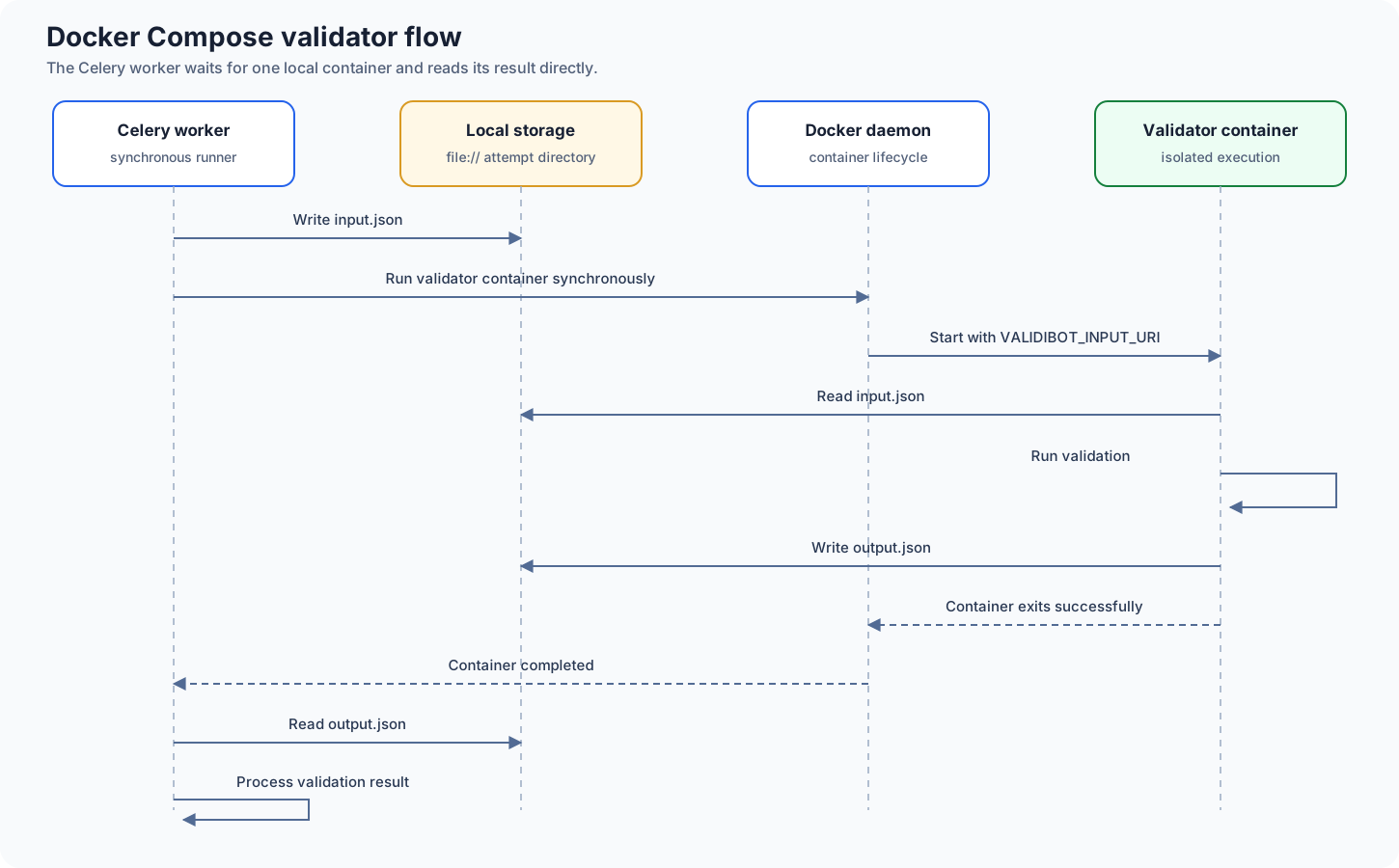
Key differences from GCP mode:
- Synchronous execution: Worker blocks until container exits
- Local filesystem: Uses
file://URIs instead ofgs:// - No callbacks: Results are read directly from storage after container exits
- Docker socket: Worker needs access to
/var/run/docker.sock
Configuration
Configure the Docker runner in Django settings:
# In settings or environment
VALIDATOR_RUNNER = "docker"
VALIDATOR_RUNNER_OPTIONS = {
    "memory_limit": "4g",  # Container memory limit
    "cpu_limit": "2.0",  # CPU limit (cores)
    "network": "validibot",  # Docker network for container
    "timeout_seconds": 3600,  # Max execution time (1 hour)
}
For Docker Compose deployments, also configure storage volume sharing:
# Storage volume (for Docker-in-Docker scenarios)
VALIDATOR_STORAGE_VOLUME = "validibot_local_storage"
VALIDATOR_STORAGE_MOUNT_PATH = "/app/storage"
DATA_STORAGE_ROOT = "/app/storage/private"
Environment Variables
All runners pass these standardized environment variables to containers:
| Variable | Description |
|---|---|
VALIDIBOT_INPUT_URI |
URI to input envelope (file:// or gs://) |
VALIDIBOT_OUTPUT_URI |
URI for output envelope (file:// or gs://) |
VALIDIBOT_RUN_ID |
Validation run ID (for logging and labeling) |
Building Containers for Docker Compose
# From validibot_validators directory
just build energyplus
just build fmu
just build-all

# Images are available locally as:
# validibot-validator-backend-energyplus:latest
# validibot-validator-backend-fmu:latest
# (same name as ValidatorConfig.image_name and cloud_run_job_name)
Docker Compose Configuration
For local development with Docker Compose:
# docker-compose.local.yml
volumes:
  validibot_local_storage: # Shared storage for validation files

services:
  django:
    volumes:
      # Docker socket for spawning validator containers
      - /var/run/docker.sock:/var/run/docker.sock
      # Shared storage volume
      - validibot_local_storage:/app/storage
    environment:
      - VALIDATOR_RUNNER=docker
      - VALIDATOR_NETWORK=validibot_validibot
      - VALIDATOR_STORAGE_VOLUME=validibot_validibot_local_storage
      - VALIDATOR_STORAGE_MOUNT_PATH=/app/storage
      - DATA_STORAGE_ROOT=/app/storage/private
Validator Container Contract
Validator containers must support both storage backends:
- Accept input URI via
VALIDIBOT_INPUT_URIenvironment variable - Support
file://URIs in addition togs://URIs - Write output to the URI specified by
VALIDIBOT_OUTPUT_URIor derived from execution bundle - Skip callbacks when
skip_callbackis set (sync mode doesn't need them)
See validibot_validators/validators/core/storage_client.py for the implementation that handles both URI schemes.
Advanced Validator Management
Enable advanced validators by listing container images in settings:
# Environment variable
ADVANCED_VALIDATOR_IMAGES=ghcr.io/mcquilleninteractive/validibot-validator-backend-energyplus:v0.15.4,ghcr.io/mcquilleninteractive/validibot-validator-backend-fmu:v0.15.3
Then sync validators from container metadata:
# Sync from configured images (reads metadata from Docker labels)
python manage.py sync_validators

# Preview without creating (dry run)
python manage.py sync_validators --dry-run

# Sync specific image (ignores ADVANCED_VALIDATOR_IMAGES)
python manage.py sync_validators --image ghcr.io/mcquilleninteractive/validibot-validator-backend-energyplus:v0.15.4

# Skip pulling images (if already present locally)
python manage.py sync_validators --no-pull
The command reads metadata from Docker labels (org.validibot.validator.metadata) and creates/updates Validator records. Validators removed from the settings are soft-deleted (set to DRAFT state).
Container Cleanup (Ryuk Pattern)
The Docker runner labels all spawned containers for robust cleanup:
| Label | Purpose |
|---|---|
org.validibot.managed |
Identifies Validibot containers |
org.validibot.run_id |
Validation run ID |
org.validibot.validator |
Validator slug |
org.validibot.started_at |
ISO timestamp |
org.validibot.timeout_seconds |
Configured timeout |
Cleanup strategies:
- On-demand - Container removed after each run (normal path)
- Periodic sweep - Background task cleans up orphaned containers every 10 minutes
- Startup cleanup - Worker removes leftover containers on startup
Manual cleanup: